Religious Icon Vector Collection: A Practical Guide to High-Quality Spiritual Graphics
When you are designing materials for a church bulletin, a faith-based blog, or a spiritual wellness brand, the visual language you choose matters immensely. It needs to convey reverence, clarity, and professionalism. This is where a well-curated Religious Icon Vector Collection becomes an invaluable asset. However, not all digital assets are created equal. Many creators rush into downloading free clipart or low-resolution images, only to find their final designs look pixelated, amateurish, or legally risky. Understanding what makes a vector collection truly useful can save you hours of frustration and ensure your message is communicated with the dignity it deserves.
Understanding the Value of True Vector Formats
The term "vector" is often thrown around loosely in online marketplaces, leading to significant confusion for beginners. A true vector file, such as SVG (Scalable Vector Graphics) or EPS (Encapsulated PostScript), is constructed using mathematical paths rather than pixels. This distinction is critical. When you scale a pixel-based image like a JPG or PNG, it eventually breaks down into blurry blocks. In contrast, a vector graphic remains crisp and sharp at any size, from a tiny favicon on a website to a large banner for a community event.
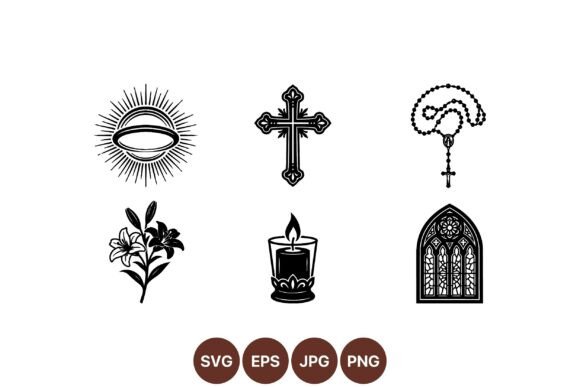
A common mistake is assuming that any file labeled "high resolution" is suitable for professional printing. While a high-DPI PNG might look good on a screen, it will struggle when printed on large formats. By choosing a collection that genuinely offers 100% vector SVG and EPS files, you future-proof your designs. You gain the flexibility to resize elements like the decorative cross or the burning candle without losing edge definition. This scalability is not just a technical luxury; it is a practical necessity for maintaining a polished, professional appearance across various media.
The Pitfall of Overly Complex Designs
In the realm of religious symbolism, there is a temptation to choose intricate, highly detailed illustrations. While beautiful, these can become problematic when used as icons. Icons are meant to be quickly recognizable and legible, even at small sizes. An overly complex stained glass window design might look stunning as a standalone piece of art, but when shrunk down for a mobile app interface or a footer link, the details merge into a muddy blob.
This is why a minimalist and spiritual approach is often more effective. Look for collections that prioritize clean lines and high contrast. For instance, a shining halo with rays should have distinct, bold lines that remain visible even when the icon is reduced to twenty pixels wide. Minimalism does not mean lacking depth; it means removing unnecessary noise so the core symbol—whether it is rosary beads or lilies—stands out clearly. This clarity improves user experience and ensures your visual communication is immediate and impactful.
Checking File Compatibility and Versatility
Another frequent oversight is ignoring the range of file formats included in a download. You might be proficient in Adobe Illustrator, which handles EPS and SVG files beautifully, but what happens when you need to send a quick preview to a client who only uses Microsoft Word? Or when you need to upload an image to a social media platform that does not support vector formats?
A comprehensive collection should include a ZIP folder containing multiple formats: SVG and EPS for editing and scaling, PNG for transparent backgrounds on web use, and JPG for universal compatibility. If a collection only offers one format, you may find yourself needing to convert files manually, which can introduce errors or degrade quality. Having access to all these formats ensures that you can work efficiently regardless of the software or platform you are using. It eliminates the bottleneck of file conversion and allows you to focus on the creative aspect of your project.
Evaluating Artistic Consistency and Style
When building a brand or a cohesive publication, consistency is key. A major error many designers make is mixing icons from different sources. One icon might have thick, rounded strokes, while another has thin, sharp lines. This visual dissonance distracts the viewer and undermines the professionalism of your work.
Before committing to a Religious Icon Vector Collection, review the entire set to ensure stylistic harmony. Do the decorative cross and the burning candle share the same line weight? Is the level of detail consistent across the rosary beads and the lilies? A well-designed collection will maintain a uniform aesthetic, making it easy to mix and match symbols without creating visual clutter. This coherence helps establish a strong visual identity, whether you are designing for a nonprofit organization, a religious educational program, or a personal blog.
Licensing and Ethical Use Considerations
Perhaps the most critical yet overlooked aspect is licensing. Religious symbols carry significant cultural and spiritual weight, and their misuse can lead to unintended offense or legal issues. Always read the license agreement associated with your download. Some free resources require attribution, while others prohibit commercial use entirely. Using a copyrighted icon in a product you intend to sell can result in cease-and-desist letters or financial penalties.
Opt for collections that offer clear, straightforward licensing terms. Ideally, look for assets that allow for both personal and commercial use, giving you the freedom to apply them across various projects without constant legal worry. This peace of mind allows you to create with confidence, knowing that your use of these sacred symbols is both respectful and compliant.
Making the Right Choice for Your Project
Selecting the right graphics is about more than just aesthetics; it is about functionality, versatility, and respect for the subject matter. By prioritizing true vector formats, embracing minimalist clarity, ensuring file compatibility, maintaining stylistic consistency, and respecting licensing terms, you elevate the quality of your work. A high-quality Religious Icon Vector Collection is not just a set of images; it is a toolkit that empowers you to communicate faith and spirituality with precision and grace. Take the time to evaluate your options carefully, and you will find that the right assets make the design process smoother and the final result far more compelling.